

YouTube-view song profile
Ranjish Hi Sahi
- Music Rank
- #101
- YouTube Views
- 40.06M
- Category
- Coke Studio
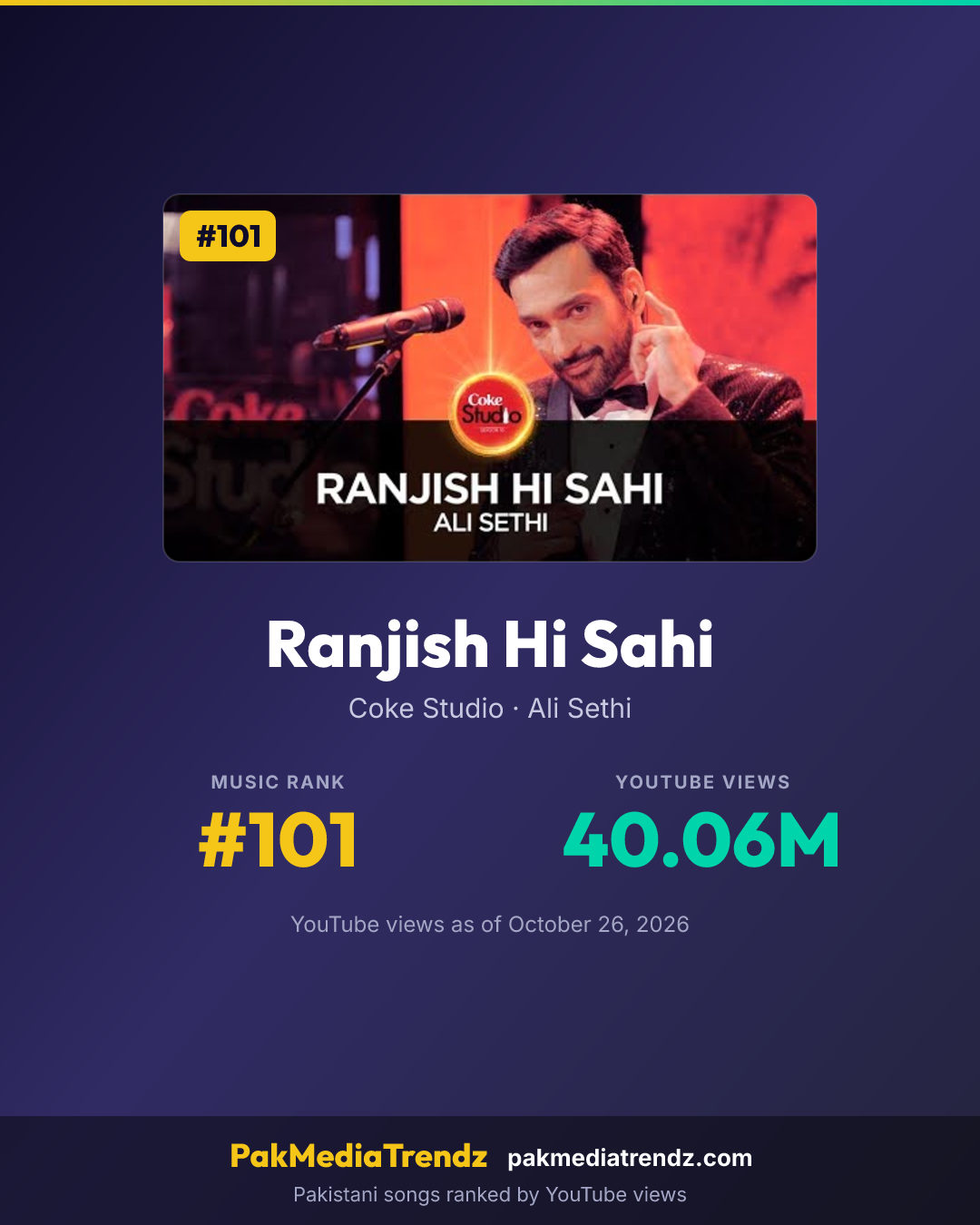
Watch Ranjish Hi Sahi
Plays here via youtube-nocookie.com — nothing loads from YouTube until you press play.
The Story Behind Ranjish Hi Sahi
Ali Sethi's Ranjish Hi Sahi revisits one of Urdu ghazal's enduring laments for Coke Studio Season 10. Released in Episode 1 in 2017, the performance pairs Ahmed Faraz's poetry and Nisar Bazmi's original composition with Jaffer Zaidi's music direction, while Strings produced and directed the session. Coke Studio framed the rendition as a tribute to Mehdi Hassan, whose celebrated interpretation is honored by the staging. Sethi keeps the emotional center intimate: his controlled, unhurried phrasing lets every plea hang in the air. Around him, keys and acoustic guitar broaden the sound, while tabla preserves the ghazal's pulse and strings and backing voices add lift. The result is a respectful bridge between a classic repertoire and Coke Studio's contemporary ensemble language.
Meaning & Translation
Ranjish is an Urdu word for hurt, displeasure, or estrangement, so the title roughly means "Even if there is resentment, let it be." Ahmed Faraz's speaker addresses an absent beloved with a painful bargain: return, even if the only purpose is to wound the heart and leave again. The invitation is not surrender so much as an admission that separation feels worse than renewed grief. As the ghazal unfolds, private longing collides with social ritual, memory, and the last stubborn hope of reconciliation. Ali Sethi's restrained delivery sharpens that contradiction. The beloved's presence promises no cure, yet the speaker would rather endure another goodbye than accept a silence that feels final.
Details
Artists & Credits
- Ali Sethi singer
- Nisar Bazmi composer
- Ahmed Faraz lyricist
- Talib Baghpati lyricist
- Jaffer Zaidi musician
- Strings producer