

YouTube-view song profile
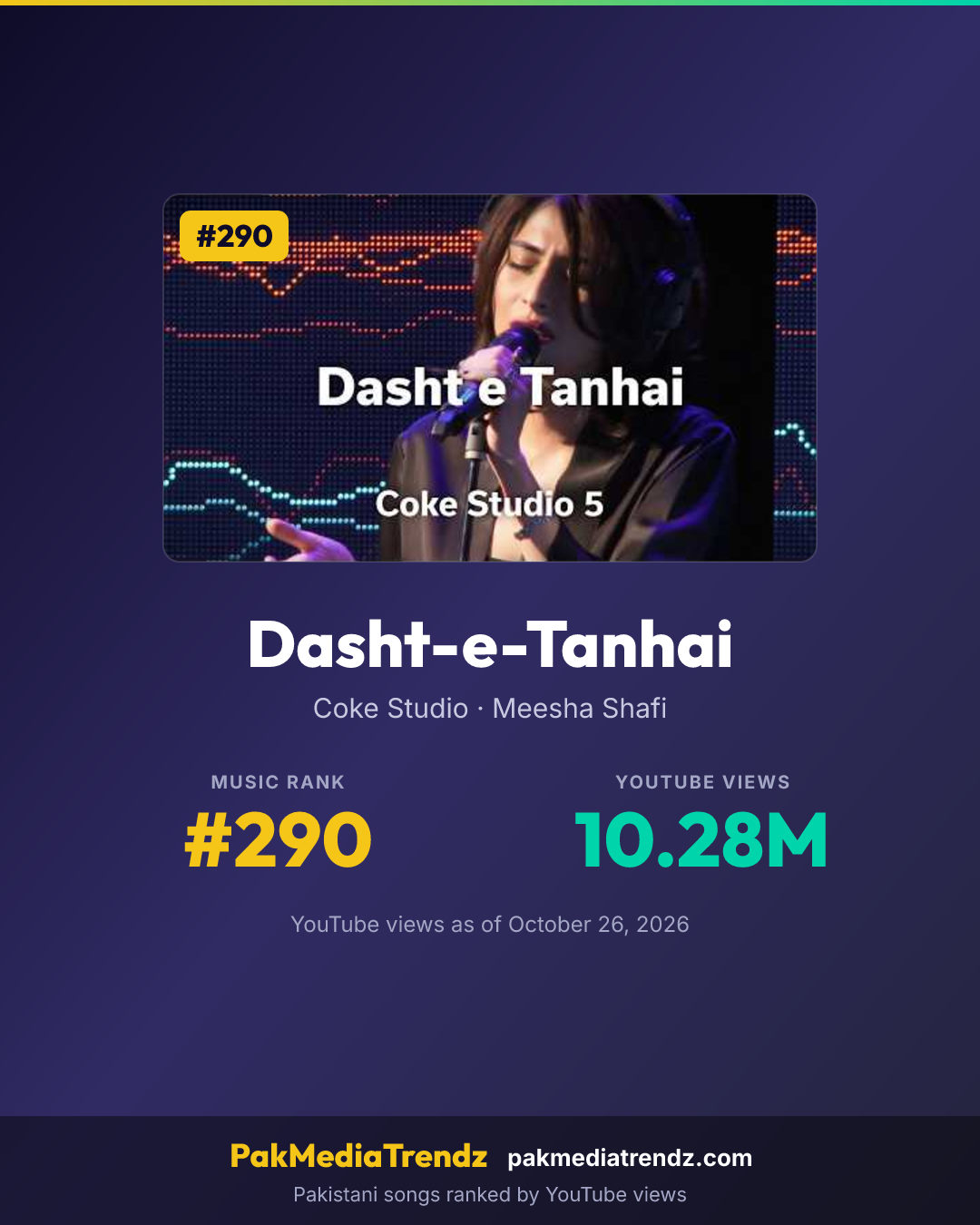
Dasht-e-Tanhai
- Music Rank
- #290
- YouTube Views
- 10.28M
- Category
- Coke Studio
Watch Dasht-e-Tanhai
Plays here via youtube-nocookie.com — nothing loads from YouTube until you press play.
The Story Behind Dasht-e-Tanhai
Meesha Shafi's 2012 Coke Studio Season 5 recording of Dasht-e-Tanhai reimagines Faiz Ahmed Faiz's Urdu nazm Yaad, a poem long associated with Iqbal Bano's rendition and Mehdi Zaheer's composition. Rohail Hyatt produced and arranged this version, giving Shafi's measured vocal room to carry its ache without theatrical excess. Wide synthesizer pads and Omran Shafique's guitar create a sense of open, suspended space, while Javed Iqbal's violin gathers intensity as the band moves toward a rock-inflected climax. The performance appeared in the season finale, where contemporary coverage noted Shafi's controlled interpretation of the classic. Its power lies in that restraint: a canonical poem is not crowded by the arrangement, but placed inside a modern soundscape that makes loneliness feel both intimate and immense.
Meaning & Translation
Dasht-e-Tanhai means "the desert of solitude," an image that turns loneliness into a vast physical landscape. Faiz's poem, originally titled Yaad, or "Memory," addresses an absent beloved whose voice, breath, and presence seem to return through remembrance. Separation is painful, yet memory transforms the barren setting: imagined flowers bloom, warmth rises, and distance briefly feels like reunion. The beloved can be heard as a person, but Faiz's language also allows a wider reading of home, freedom, or an ideal kept alive across distance. Meesha Shafi's restrained delivery preserves that ambiguity. The song is less a narrative of loss than an account of memory overcoming absence, if only for a moment.
Details
- Artist
- Meesha Shafi
- Category
- Coke Studio
- Collection
- Coke Studio Season 5
- Released
- 2012
- Language
- Urdu
- Mood
- Melancholy, Romantic
- YouTube Views
- 10.28M
Artists & Credits
- Meesha Shafi singer
- Mehdi Zaheer composer
- Faiz Ahmed Faiz lyricist
- Javed Iqbal musician
- Omran Shafique musician
- Rohail Hyatt producer